
A parent asked me a question recently that I still think about: “My son is neurodivergent, and I don’t know the best way to help him regulate when he gets escalated and anxious. What do I do?”
If you’re parenting a neurodivergent child, you may have asked the same thing. Maybe at 9 p.m. after a hard bedtime. Maybe in the car after school pickup, when the meltdown you saw coming finally arrived.
I love this question. Neurodivergent kids are some of my favorite people to work with. Once you get to know them, there are golden nuggets in their personalities that are so much fun. Still, regulation and sensory experiences can be a real, daily challenge, both for the child and for the parent trying to help.
Here’s what I’ve learned, from the therapy room and from my own home.
Start With What Actually Helps Your Neurodivergent Child, Not What Looks Right
The first step is learning what genuinely helps your child regulate, regardless of whether it looks socially accepted. Chewing on things. Rocking. Pacing. Repeating a phrase.
As parents, our instinct is often to correct the behavior because it looks unusual. However, if it’s doing the job of calming their nervous system, that behavior is information, not a problem to eliminate.
So before you redirect anything, get curious. Watch for patterns over a week or two:
- When does the behavior show up? Before school, after a loud event, at bedtime?
- What happens right before it? A transition, a crowded room, a scratchy shirt?
- How does your child seem afterward? Calmer, more focused, more connected?
In many cases, your neurodivergent child is already showing you exactly what their body needs. Your job is to notice it and name it, rather than shut it down.
Turning Sensory Tools Into Supports Your Child Can Use Anywhere
The second step is helping them find a socially acceptable version of that same tool. For example, a child who chews on a shirt sleeve or pencil to self-soothe will likely get teased for it as they get older. That doesn’t mean the underlying need for chewing goes away. Instead, it means we look for a chewable necklace, a fidget, or something else that gives the nervous system what it’s asking for without costing the child socially.
A few other swaps I often suggest to families:
- Rocking → a rocking chair at home, a wobble cushion at a desk, or a few minutes on a swing after school
- Pacing → scheduled movement breaks, a classroom errand, or walking while talking through a hard moment
- Repeating a phrase → a short, calming script your child chooses and practices when they’re already calm
- Covering ears → noise-reducing headphones for the cafeteria, assemblies, or the grocery store
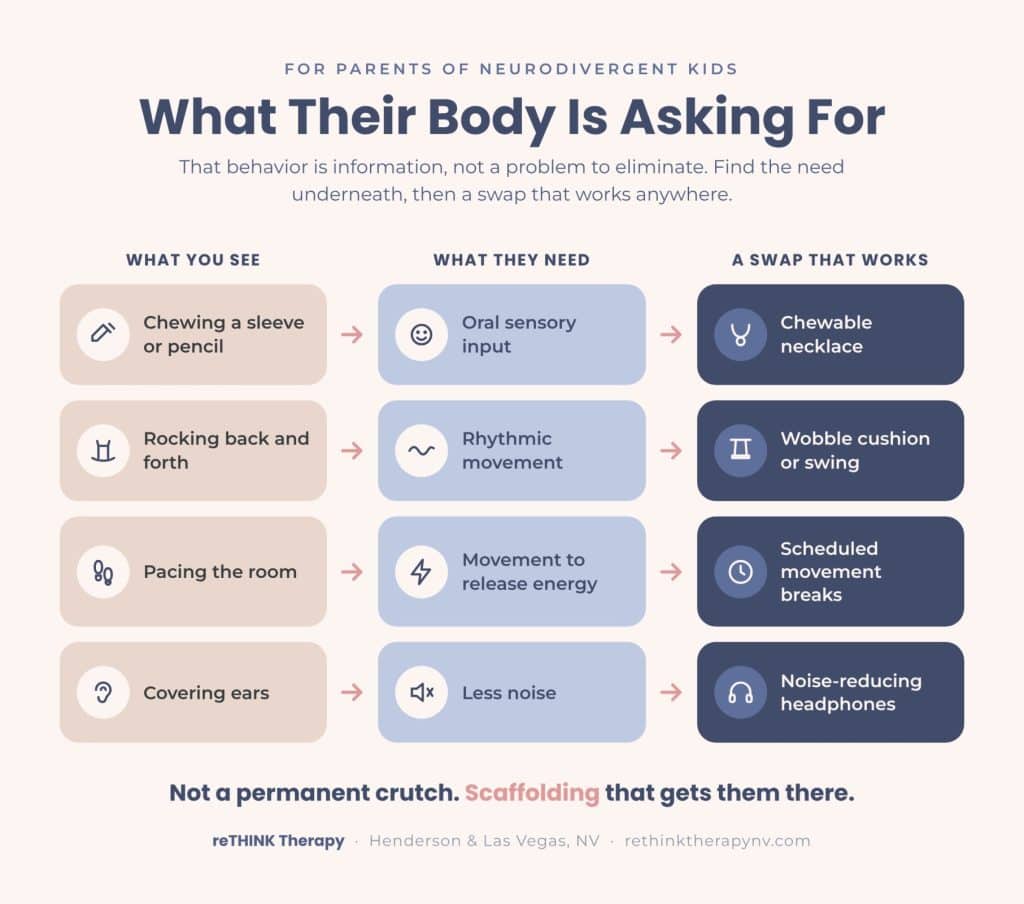
This part matters: these tools aren’t a permanent crutch. A neurodivergent child who needs heavy support to regulate at age eight isn’t necessarily going to need that same support forever. Right now, though, they may need more scaffolding to function at their age, and that scaffolding is what gets them there.
The Regulation Gap Is Real, and It’s Not a Character Flaw
Here’s something I tell parents constantly: neurodivergent kids often take much longer to develop the same regulatory skills as their peers. An eight-year-old might genuinely have the emotional regulation of a four-year-old.
That’s not a discipline problem. It’s a developmental gap, and it closes at its own pace, not on the timeline the school calendar or extended family expects.
Understandably, that gap can feel discouraging if you’re measuring your child against a same-age sibling or classmate. Even so, the goal was never to have a child who matches an average. The goal is a child who eventually functions well as themselves, with whatever support gets them there.
Practically, this means meeting your neurodivergent child where their regulation actually is, not where their birthday says it should be. A four-year-old’s nervous system needs a calm adult nearby, simple words, and fewer choices in the middle of a meltdown. Lectures, consequences, and problem-solving can wait until everyone is calm again. Co-regulation comes first; teaching comes later.
Advocating for Your Neurodivergent Child at School in Henderson and Las Vegas, NV
Beyond regulation tools at home, the next piece is advocacy. You have to be willing to come to the table with your child’s school and say clearly what they need.
In my experience working with families across Henderson and Las Vegas, schools sometimes push back at first. Once a need has been clearly and specifically advocated for, though, schools generally want to meet it. A regulated child does better academically and socially, and yes, also disrupts the classroom less. Schools have their own incentives here, and you can use that.
A few things that make advocacy more effective:
- Be specific. “He needs movement breaks every 30 minutes” lands better than “He needs more support.”
- Bring what works at home. Share the tools you’ve already tested, like the chewable necklace or headphones.
- Put it in writing. Follow up every meeting with a short email summarizing what was agreed.
- Ask about formal supports. Depending on your child’s needs, a 504 plan or an IEP may make accommodations official.
Here’s the part that catches parents off guard: advocacy is not a one-time conversation. You will likely have to restate your child’s needs over and over, sometimes to the very same school, in the very same school year. Teachers change. Substitutes come in. Staff forget.
That’s not a sign that you did it wrong the first time. Rather, it’s simply what advocacy for a neurodivergent child with ongoing needs looks like.
A Different Way to Measure Progress
If you’re raising a neurodivergent child, let go of measuring progress against what’s typical for their age. Instead, measure it against your own child a month ago, or a year ago.
- Is the regulation tool working better than it used to?
- Is the meltdown shorter than it was last semester?
- Is the school actually hearing you now, even if it took three conversations to get there?
That’s the real scoreboard. Not comparison to a sibling, a classmate, or a chart in a parenting book.
Finding Support for Your Neurodivergent Child in Henderson and Las Vegas, NV
At some point, many parents realize they’re carrying a lot. Between meltdowns, school meetings, and the constant work of figuring out what helps, it’s easy to run on empty.
That’s where therapy can help, both for your child and for you. A therapist who works with kids and teens can help your child build regulation skills at their own pace, while also helping you understand what their behavior is communicating. Parents often leave sessions with new tools, a clearer plan for school conversations, and a little more breathing room.
At reTHINK Therapy, our therapists work with children as young as four, along with teens and parents, right here in Henderson and across the Las Vegas Valley. We accept many insurance plans, and we’ll call you back within one business day.
The Bottom Line
Your neurodivergent child isn’t a puzzle to be solved or a behavior to be corrected into looking typical. They’re a kid with a nervous system that works differently, who needs you to find what actually helps them, translate it into something the world can accept, and advocate loudly and repeatedly until the systems around them catch up.
That’s not a failure of parenting. That’s the job.
And if you’re finding that job harder than you can carry on your own, reaching out for support for yourself or for your neurodivergent child is not giving up. Often, it’s the most effective next step you can take.